Adventurussia
Home Destinations Kamchatka
Three hundred volcanoes, twenty-nine of them active, a peninsula about half the size of France and just two hundred ninety thousand inhabitants. The only way in is by air, nine hours from Moscow and nine time zones east of it: it is the most distant trip we organize, and the one people come back most changed by.
Why go
No road links Kamchatka to the rest of the country. Everything that arrives here comes by ship or by plane, and it shows: outside Petropavlovsk, the peninsula is a succession of volcanoes, tundra, rivers full of salmon, and bears fishing for them. Six parks here are listed together as a single UNESCO World Heritage Site.
It is also a demanding trip, and we would rather say so. Excursions depend on the weather; a helicopter flight can be postponed by two days; lodgings are simple. In return, you walk on a volcano in the morning and bathe in a hot spring in the evening, without meeting a soul.
What to see
The volcanoes are hiked, the geysers are flown over, the bears are watched from a platform.
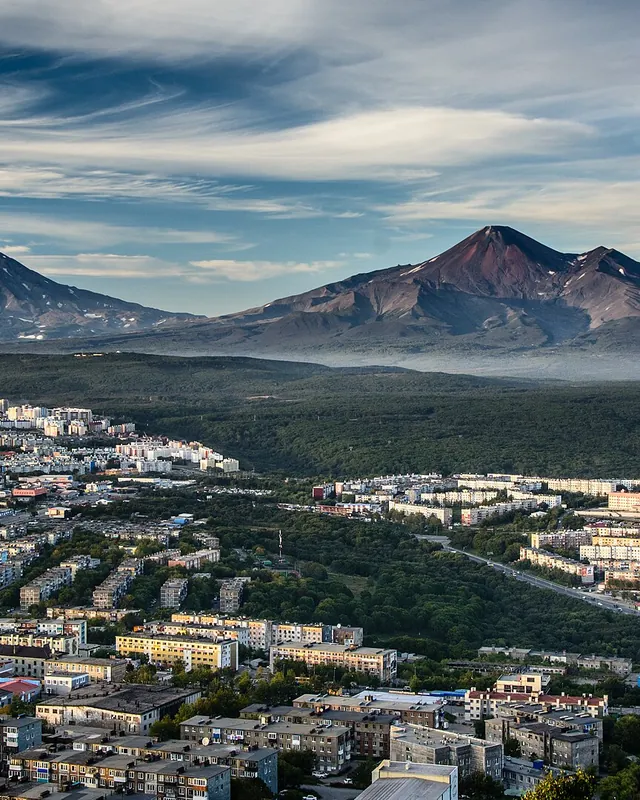
Avachinsky and Koryaksky tower over the city and can both be climbed — Avachinsky in a long but non-technical day, up to its steaming crater at 2,700 m (8,900 ft).
Twenty geysers in an enclosed canyon, reachable only by helicopter. An hour's flight, two hours on the ground, and the feeling of being somewhere you should never have been able to reach.
The highest concentration of brown bears in the world, during the sockeye salmon run. You watch them from platforms, with a guide, a few dozen meters away. July to September.
The second-largest bay in the world, with the Three Brothers, the rocks standing at its entrance. A day by boat: puffins, seals, sometimes orcas, and halibut fishing.
Paratunka and the pools of the valley: water at 40 °C (104 °F) in the open air, often under falling snow. It is what the locals do all year round, and it is what soothes you after days of hiking.
A thirty-kilometer (nineteen-mile) beach of black volcanic sand, open to the Pacific. Too cold for swimming, exactly the right temperature to understand where you are.
When to go
July, August and September: outside those months, the passes are under snow and the helicopters don't fly.
July – August
The only real window: the snow has cleared the passes, the helicopters fly, the bears are fishing, and it is 15 to 20 °C (59 to 68 °F). This is when everything happens, and you need to book six months ahead.
September
Our favorite: the tundra turns red, the mosquitoes are gone, the bears are still fishing and the helicopters are less crowded. A slightly higher risk of bad weather.
February – April
The Kamchatka of ski touring, snowmobiles and sled dogs: superb, and for active travelers only. The geysers can no longer be visited.
May – June, October – January
Snowmelt, fog, closed passes, grounded helicopters. These are the months when we will frankly advise you to choose another destination.
Practical info
A nine-hour overnight flight from Moscow, on an Airbus. There is no other way to get there, and no daily flight in the low season. Allow at least two days of travel from home, connections included.
Off-road trucks, boats and helicopters: nothing is done by ordinary car. Everything is booked and paid in advance in our programs, helicopter included, since it fills up months ahead.
Eight days at the very least, ten to absorb a day lost to the weather. Staying any shorter means risking a nine-hour flight just to see fog.
Broken-in hiking boots, a waterproof layer, and something warm even in August. We send you a detailed list: here, the right gear makes the difference between a wonderful day and a miserable one.
The visa calls for a little extra lead time here: some areas of the peninsula are restricted and excursions must be declared, which we take care of. The visa itself is the ordinary tourist e-visa — our page on the Russian visa gives the details, and Venir en Russie (in French) follows the application step by step.
Kamchatka is almost always combined with Vladivostok: the two are three hours apart by air, so you can take in the whole Russian Far East in a single two-week trip.
Other destinations:
Kamchatka with us
Helicopter seats, park permits, off-road trucks, a high-mountain guide: none of this can be found on the spot at the last minute. We set it all up from Russia, with our dedicated English-speaking team, well before you leave.
Kamchatka after Vladivostok: two weeks in the Far East, from the Trans-Siberian to the volcanoes, at your dates and your pace.
Or let's talk about your dates first: summer is booked from the winter before.