Adventurussia
Home Destinations Vladivostok
Nine thousand two hundred and eighty-eight kilometers after Moscow, the Trans-Siberian stops facing the Pacific. A city of hills and bays, beneath the cables of two giant bridges, where Russia eats Korean-style and is best seen from a lighthouse at the end of a sand spit.
Why go
Vladivostok looks like nowhere else in Russia. Its hills are San Francisco's, the sea reaches in everywhere, and the Asian influence shows in the restaurants as much as in the faces: this is where the country touches China, Korea and Japan.
It is also a fortress city, bristling with batteries and tunnels dug at the end of the 19th century, and long closed to foreigners, and even to Soviet citizens without a permit, until 1992. That history can still be seen, and it partly explains the pride you feel here.
What you will see
The kilometer 9288 station first: that is where the journey ends, or begins.
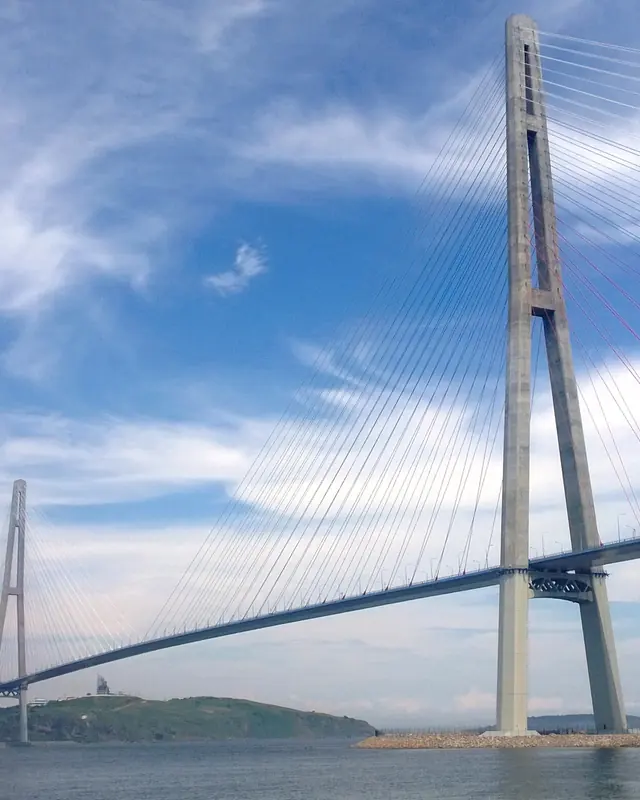
The cable-stayed bridge with the longest span in the world: 1,104 meters in a single stretch to Russky Island. You cross it, then stop on the other side to look back at it.
The cliffs of Cape Tobizin, deserted beaches, abandoned forts in the forest, and the oceanarium. A whole day, and you still haven't seen half the island.
At the end of a sand spit that the tide covers. You walk out between two seas, and it is the photo everyone brings home from Vladivostok.
The funicular climbs to Eagle's Nest Hill, with a view over Golden Horn Bay, the two bridges and the ships. Go there on arrival, to take in the city at a glance.
King crab, scallops, sea urchins, and the best Korean food in Russia. You eat here for a third of Moscow prices, and often better.
The World War II submarine, open to visitors on the waterfront, and the 1912 station, twin of the one in Moscow, with its kilometer 9288 marker.
When to go
A misty summer, a magnificent fall, a dry and windy winter. The season matters more here than anywhere else.
June – July
Warm but misty: the summer monsoon sometimes wraps the city in fog for several days. Contrary to what many think, it is not the best time.
August – September
The sea at twenty-three degrees (73 °F), clear skies at last, the beaches of Russky Island open for swimming. By far the best season.
October
The famous “golden autumn” of the Far East: bright, dry, fifteen degrees (59 °F), and the taiga turning red around the bay. Superb, and very few visitors.
December – March
Dry, sunny and freezing: the Siberian wind sweeps down over the sea. People come then for the light and the crab, not for walks.
Practical information
Eight hours by air from Moscow, seven time zones further east, or six days on the Trans-Siberian, which remains the most beautiful way to arrive.
The hills discourage walking: taxis and minibuses. Russky Island calls for a car for the day, included in our itineraries.
Two days for the city, three with Russky Island. It is both an end point and a starting point: many travelers continue on to Kamchatka or Korea.
Cash: bank cards issued outside Russia do not work there. Prices are low outside the hotels, and food is the real luxury here: plan a restaurant budget, it is worth it.
The visa deserves a mention here: Vladivostok long had its own simplified scheme, which no longer exists. Today the same rules apply as everywhere else in Russia. Our visa page explains them, and Venir en Russie guides you through the online application (in French).
Vladivostok is the terminus of the Trans-Siberian: you arrive after Lake Baikal and Yekaterinburg. We can organize that whole journey for you, from end to end, at your own pace.
Other destinations:
Vladivostok with us
Vladivostok is reached in seven nights by train or one night by plane, and both are booked from within Russia. We book the tickets, the hotel on the bay, and the English-speaking guide who knows the islands.
It can be the last stop of a tailor-made Trans-Siberian journey: your dates, your pace, the stops you choose along the way, and a private English-speaking guide.
Or fly in for the Far East alone, on a program written just for you.