Adventurussia
Home Destinations Murmansk
The largest city in the world above the Arctic Circle, and a port that never freezes — the Gulf Stream reaches all the way here. You don't come for the monuments: you come for the sky, between September and March, when the northern lights rise above the bay.
Why go
This has to be said before anything else: nobody can guarantee you the northern lights. They need a dark night, a clear sky and enough solar activity — and the first two conditions are missing one night in two in Murmansk. That is why we never sell fewer than four nights: with four nights, your odds go from poor to very good.
The rest of the trip stands on its own. The tundra in winter, the nuclear icebreaker open to visitors, sled dogs, the village of Teriberka on the Barents Sea, and the Sami reindeer herders: you come home with the Far North, northern lights or not.
What to see
The northern lights are watched for at night; the days are easy to fill.
You head out of town by minibus, often a hundred kilometers or so, to find a gap in the clouds. Outings leave around 9 p.m. and return in the middle of the night; you wait outside, kept warm, and you look up.
The world's first nuclear-powered surface ship, moored downtown and turned into a museum. The engine room, the bridge, the cabins: an hour that is worth the trip.
A hundred and fifty kilometers of road, and then the Barents Sea. The village from the film Leviathan: stranded boats, a graveyard of fishing boats, a beach of "dragon eggs." Wild, and now very much photographed.
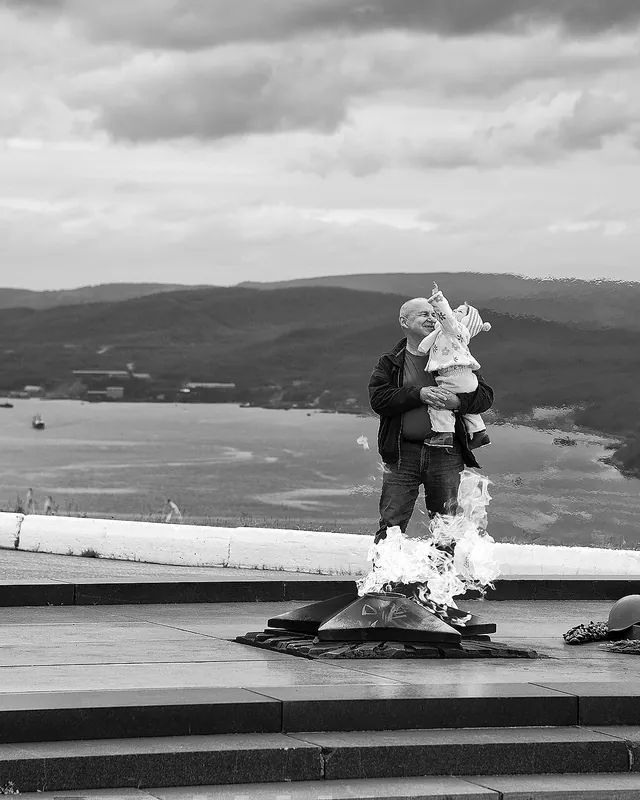
The thirty-five-meter (115-foot) concrete soldier watching over the bay, raised for those who defended the Soviet Arctic. From his feet, you can see the whole port and the icebreakers at the quay.
An hour's drive inland: husky kennels, a Sami camp, a reindeer herd. It is what remains of a people who lived here long before the port.
Snowmobile, snowshoes, or simply a stop by a frozen lake at noon, when the sun skims the horizon without rising. In December, daylight lasts four hours, and it is blue.
When to go
The sun disappears for six weeks, then doesn't set for two months. Here is when to come, and for what.
December 2 – January 11
The sun does not rise at all. Two hours of blue twilight a day, and the best nights for the northern lights. It is the most intense experience, for those who can handle it.
September – March
The northern lights months. September and March have the advantage of often clearer skies and normal days: you sightsee by day and watch the sky by night.
April – May
The snow still holds, the nights shorten quickly, and the northern lights fade away. A lovely season for the tundra, a poor one for the sky.
May 22 – July 22
The sun never sets. Hiking, fishing, Teriberka without snow, and not the slightest aurora — you have to choose what you are coming for.
Practical info
A two-and-a-half-hour flight from Moscow, or twenty-seven hours by train from Saint Petersburg, which is a journey in itself. We book one or the other with you.
Nothing is possible without a vehicle: the northern lights, Teriberka and the reindeer are all outside town. Our programs include the minibus, the driver and an English-speaking guide.
Four nights is the honest minimum for the northern lights. Five if you want Teriberka without rushing. Fewer than three nights, we would rather advise you against it than sell it to you.
Minus 20 °C (−4 °F) in January, with the wind off the bay. Overalls, boots and mittens are provided for the night outings; for the rest, we send you the list before you leave.
As for the visa, nothing special above the Arctic Circle: it is the ordinary Russian visa, requested for the full length of your stay. Get it before you buy your ticket, and we prepare the application with you — our page on the Russian visa lists the documents, and Venir en Russie (in French) guides you through the online application.
Twenty-seven hours by train link Murmansk to Saint Petersburg: four nights of northern lights after three days of palaces is the winter trip our clients ask for most often.
Other destinations:
The Far North with us
Every evening, our drivers check the cloud cover and the solar activity index, then decide which way to go. That is what makes the difference between four nights of waiting and four nights of green sky.
Four nights of northern lights after three days in Saint Petersburg: our most requested winter trip, at your dates and your pace.
Or first browse our sample itineraries: a private English-speaking guide, a private driver, the hotels you choose, a program written for you.