Adventurussia
Home Destinations Yekaterinburg
Where Europe becomes Asia, 1,800 kilometers from Moscow. A city of factories and mines that has grown into Russia's fourth largest, with glass skyscrapers rising amid one of the finest constructivist ensembles in the world — and the place where the story of the Romanovs came to an end.
Why go
Yekaterinburg is not a postcard city, and that is exactly its strength. Here you see the Russia that works, the Russia of Ural factories and engineers, with a very lively cultural scene and young people who have made the city the capital of Russian street art.
It is also the most memorable stop on the Trans-Siberian between Moscow and Lake Baikal. Two days are enough to see it, and you leave with something the two capitals don't give you: the feeling of having seen the country, not just its shop windows.
What to see
The border between Europe and Asia is twenty minutes from downtown. Naturally, you stop there.
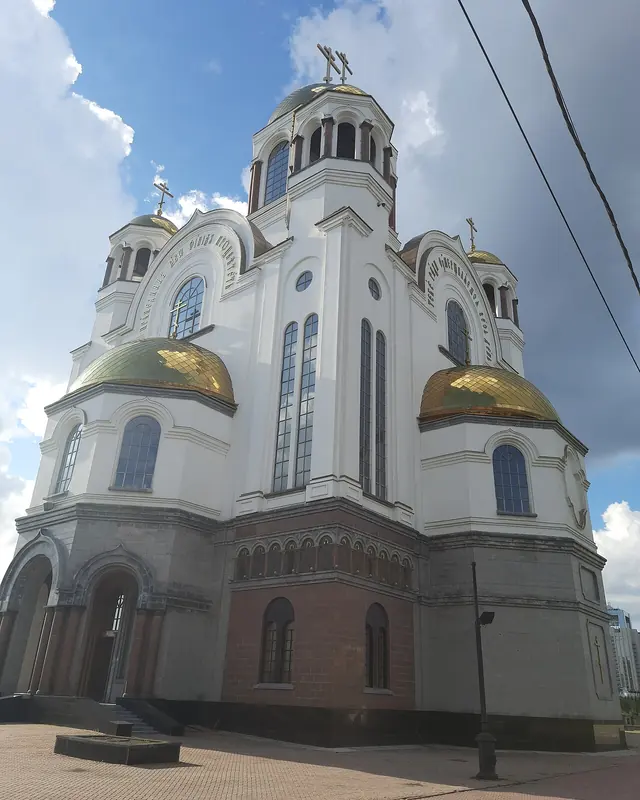
Built on the very spot where the imperial family was shot in July 1918. Golden domes, a silent crypt, and an emotion that takes by surprise even those who never cared about Russian history.
About twenty kilometers out of town, an obelisk marks the passage from one continent to the other. You stand with one foot on each side, you laugh, you take photos — and suddenly you grasp the sheer size of the country.
The wooden monastery with seven chapels, built where the bodies of the Romanovs were first thrown. A place of forest and silence, fifteen kilometers from the city.
The Gorodok Chekistov and its buildings shaped like a hammer and sickle: 1930s architecture on the scale of an entire neighborhood. Unique in Europe.
Fifty-two floors and a viewing deck overlooking the city, the lakes and the first ridges of the Urals. Go at sunset on your first evening.
Malachite, jasper, crystal: the mineral museum and the stone-cutting workshops tell of the wealth that gave birth to the city. Bazhov's Ural Tales were born here.
When to go
Minus 30 °C (−22 °F) in January, plus 30 °C (86 °F) in July. We tell you which season works for a traveler from abroad.
May
The snow melts late in the Urals. May is cool but bright, and the city empties out to the dachas with the first fine days.
June – August
An average of 22 °C (72 °F), the lakes around the city, hikes among the Shartash rocks. The right season, no question.
September
The Ural forest in gold and red, superb light, and evenings that are already cool. An excellent time for a short stop.
November – March
Minus 20 °C (−4 °F), no exaggeration. Beautiful under snow, grueling without the right gear — we only recommend it to travelers who have already been once.
Practical info
A two-and-a-half-hour flight from Moscow, or twenty-five hours by train if the Trans-Siberian is part of the plan. We book either one for you, along with everything else.
Downtown is walkable, and the tram line does the rest. The Europe-Asia border and Ganina Yama require a car: it is included in our programs.
Two full days cover the city and both excursions. Three if you want to hike in the Urals. It is a stop along the way, rarely a destination on its own.
Cash, as everywhere in Russia, since bank cards issued abroad do not work there. The city is much cheaper than Moscow: a very good restaurant costs about what a casual brasserie meal does in Paris.
Finally, the visa. Yekaterinburg is not a common international point of entry: you almost always arrive via Moscow, and that is where the check takes place. Our visa page explains which one to apply for; Venir en Russie (in French) walks you through the form screen by screen.
Yekaterinburg is the first major stop on the Trans-Siberian after Moscow, before Irkutsk and Lake Baikal. That is how we most often suggest it.
Other destinations:
The Urals with us
Yekaterinburg does not live off tourism: that is what makes it worthwhile, and what makes it hard to visit alone, with few signs or menus in English. Our guides are from here, speak English, and tell the story of the Romanovs and of the wartime factories with the same precision.
Yekaterinburg fits naturally into a tailor-made Trans-Siberian journey: your dates, your pace, a private English-speaking guide, a private driver, the hotels you choose.
Or add the Urals to a program written just for you.