Adventurussia
Home Destinations The Trans-Siberian
Tea made with boiling water from the carriage samovar, the taiga rolling past for an entire day, a station at dawn where you step out onto the platform in your slippers for twenty minutes. Nine thousand two hundred eighty-eight kilometers between Moscow and the Pacific: the Trans-Siberian is not a way of getting somewhere, it is the journey itself.
Why go
Begun in 1891 in Vladivostok and completed in 1916 with the bridge over the Amur at Khabarovsk, the line is the longest in the world served by a regular train. Train No. 2, the “Rossiya,” covers it in one go in just under seven days. You cross from Europe into Asia in the Urals, cross the Ob, the Yenisei and the Amur, run alongside Baikal for several hours, and move your watch forward seven hours along the way.
Should you do it in one go? Rarely. Seven days without getting off is quite an experience, but also a great many birch trees and bunks. We almost always recommend breaking the journey into four or five stages: one or two nights on board, then two or three days in town, with Baikal as the heart of the trip. You can also do just half: Moscow–Irkutsk, or Irkutsk–Vladivostok.
What to see
From west to east. In between, you sleep on board: the longest stretches last a day and a half.
A little over 1,100 miles from Moscow, the first major stop. A monument marks the border between Europe and Asia a few miles from the city, and it was here that the family of Nicholas II was executed in 1918, on the site of today's Church on the Blood.
Russia's third-largest city was born of the Trans-Siberian construction site, for the bridge over the Ob. Few monuments, but a very large opera house, an open-air railway museum and, nearby, the science town of Akademgorodok.
The city spreads along the Yenisei, and just to the south, the Stolby nature reserve raises its granite pillars amid the taiga: a day's walk to stretch your legs after two nights on the train.
The reason most travelers take the Trans-Siberian. Irkutsk keeps its carved wooden houses, and Baikal, the deepest lake in the world, is an hour's drive away: Listvyanka, the Circum-Baikal Railway, and Olkhon Island for those with three more days.
Beyond Baikal, Siberia turns Buddhist. The Ivolginsky Monastery, the center of Russian Buddhism, is half an hour from the city, and Buryat cuisine (buuz, steamed dumplings) makes a pleasant change from the dining car.
A kilometer post marked 9,288 on the station platform, hills, bridges, the Pacific, and the Russian fleet in Golden Horn Bay. A port city that looks more toward Korea and Japan than toward Moscow.
When to go
The train runs all year round and is heated in winter. It is what you do at the stops that depends on the season.
April – May
Siberia thaws late: snow lingers in April, mud follows, and Baikal only breaks free of its ice in May or early June. Few travelers, and tickets are easy to find.
June – August
The best season for hiking at Baikal, swimming (briefly) and enjoying the stops. Trains are full, since Russians travel too: book early. Not all carriages are air-conditioned.
September – October
September is our favorite month: the taiga turns yellow and red, the mosquitoes are gone, the trains empty out. The first snow can fall in Siberia as early as October.
December – March
Siberia at −22°F (−30°C) seen from a carriage at 75°F (24°C), and in February and March the transparent ice of Baikal, which you can walk on. You need proper gear for the stops, and the days are short.
Practical info
SV, or first class, is a two-berth compartment; kupe has four, with a door that closes, and it is the most common choice; platskart is an open carriage of fifty-four berths with no partitions, the liveliest and least private. All come with bed linen and unlimited hot water.
Each carriage has its provodnitsa, the attendant who runs the carriage, sells tea and wakes you before the stations. You bring your own provisions (noodles, bread, fruit) and use the longer stops, twenty to forty minutes, to buy food on the platform. Most carriages have no shower, and there is no Wi-Fi worth the name in Siberia.
Seven days on the train nonstop from end to end. With four or five stages, allow two and a half to three weeks. Moscow–Baikal alone, with two stops, takes ten to twelve days.
Bank cards issued outside Russia do not work there, on the train or anywhere else. Bring enough cash in euros or dollars for the whole trip, exchanged in Moscow or in the larger cities along the way: small stations have no exchange office.
Before you leave, one precaution specific to the Trans-Siberian: a long trip with stops can quickly exceed the length of stay the e-visa allows, so check this as soon as you choose your dates. Our page on the Russian visa in 2026 compares the options, and the Venir en Russie website explains how to fill in the application (in French).
The Trans-Siberian is already a combination in itself: Moscow at the start, often for a few extra days, then Kazan if you take the Volga variant, Yekaterinburg, Baikal, Vladivostok. After Baikal, at Ulan-Ude, you can also branch off toward Mongolia on the Trans-Mongolian, or finish with a flight from Vladivostok to Kamchatka. For prices and booking, see Trans-Siberian tickets and prices.
Other destinations:
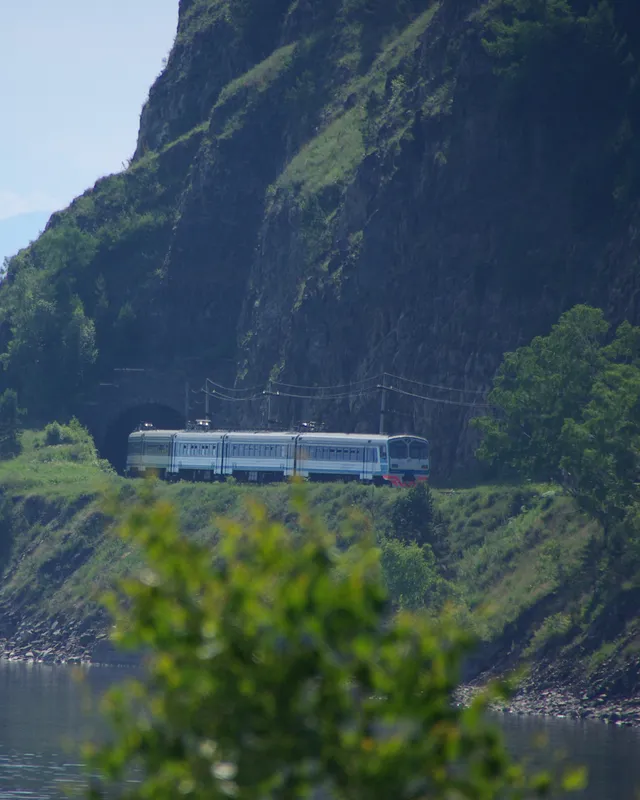
Header photo: Artem Svetlov from Moscow, Russia, Wikimedia Commons (CC BY 2.0).
The Trans-Siberian with us
The Trans-Siberian is not one train you board once, but five or six trains, as many hotels and transfers, and timetables in local time across seven time zones. We book the tickets from Moscow, choose the carriages, and arrange a welcome in English at every stop.
In one go or in stages, the whole line or half of it, at your dates and your pace: we build the journey together.
Or let’s talk about season and length first: we answer in English within 48 hours.