Adventurussia
Home Destinations Pskov and Pechory
Gray limestone walls where two rivers meet, squat white churches beneath small arched belfries and, fifty kilometers away, monks who go down every day into caves dug in the sand. Pskov is Russia's western frontier, an hour's drive from Estonia: a city that spent centuries defending itself and kept the sobriety that came with it.
Why go
Pskov was a merchant republic, the younger sister of Novgorod, then Muscovy's western stronghold against the Livonian knights, the Poles and the Swedes. It built accordingly: thick ramparts, and churches of local stone, low and free of needless ornament, which UNESCO listed in 2019 as the Churches of the Pskov School of Architecture. The center is easy to explore on foot, and you meet few foreign visitors.
Around it, the region holds three visits that alone justify the trip: the Pskov-Caves Monastery in Pechory, one of the few Russian monasteries that stayed open without interruption throughout the Soviet era; the Izborsk fortress, on its headland above a valley of springs; and, further south, the estate where Pushkin wrote part of his work. You need a car and a little time, but distances remain short.
What you will see
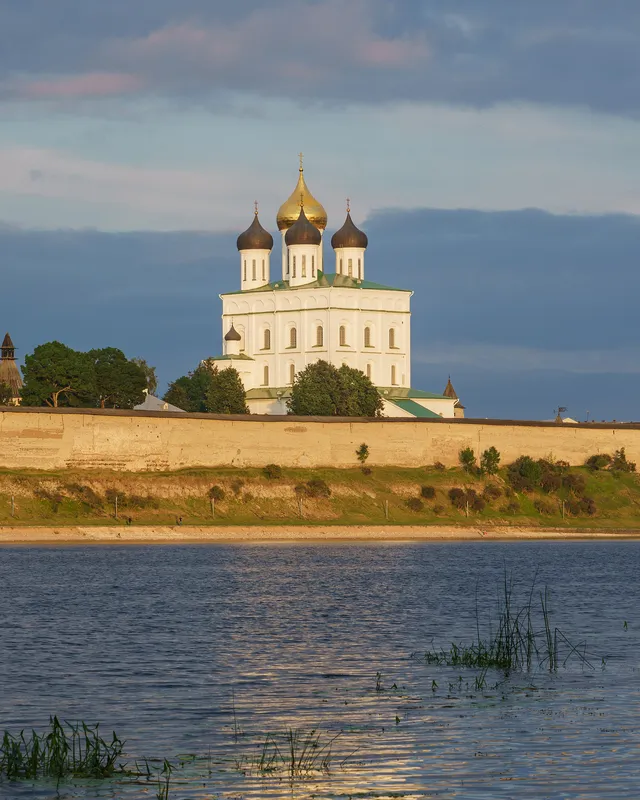
The kremlin at the end of the day, seen from the other bank of the Velikaya: that is the view locals show you first.
The Krom, as it is called here, occupies the point between the Velikaya and Pskova rivers. Its limestone walls enclose the Trinity Cathedral, completed in 1699, whose golden dome can be seen from all over the city.
An architecture of whitewashed limestone, with simple volumes and wall belfries pierced by arches where the bells hang. Ten ensembles are UNESCO-listed, including the Mirozhsky Monastery and its 12th-century frescoes, among the oldest preserved in Russia.
Officially founded in 1473 around caves dug into the sand, it lies below the town, behind a crenellated wall. Monks still live here, and you can visit the galleries where thousands of the dead rest, by candlelight, with a monk as your guide.
About thirty kilometers from Pskov, 14th-century walls on a rocky spur, and below them the Slovenian Springs flowing out of the cliff in twelve streams. One of the most peaceful landscapes in the region.
The family estate of Mikhailovskoye, where Pushkin was exiled in 1824 and wrote Boris Godunov, the neighboring estates of Trigorskoye and Petrovskoye, and his grave at the Svyatogorsky Monastery. Just over a hundred kilometers south of Pskov: a full day.
Along the Velikaya, upstream from the center, a monastery with 14th-century frescoes and a riverside promenade that locals use more than tourists. The right place to see how the city lives.
When to go
The excursions take you into the countryside, by car and on foot: the warm season is the most comfortable.
April – May
The rivers rise and the countryside turns green late, around mid-May. Few visitors, and a very clear light on the limestone walls.
June – August
Long days, mild weather, rarely very hot. This is the season for Pushkinskiye Gory, when the estate parks are at their loveliest, and also when Pechory sees the most pilgrims.
September – October
September is ideal: the forests around Izborsk turn yellow and the weather stays dry. October turns rainy and the days shorten quickly.
December – March
A damp rather than frozen winter, between −5 and −10 °C (23 to 14 °F), with little daylight. The Pechory monastery under snow is beautiful, but country roads call for caution.
Practical information
A nightly train from Moscow's Leningradsky station takes about twelve hours; a few flights a week take around an hour and a half. From Saint Petersburg, the Lastochka takes three and a half to four hours. We book the tickets with you.
Pskov is easy to explore on foot. For Pechory, Izborsk and Pushkinskiye Gory you need a car with a driver: buses exist but won't let you link everything together. Pechory is a few kilometers from the Estonian border: carry your passport, and stay well away from the border line.
Three days at least: one for the city, one for Pechory and Izborsk, which go together, and one for Pushkinskiye Gory. Four if you want to take your time.
Bank cards issued outside Russia do not work there: bring cash, euros or rubles. At the monastery, keep small change for candles, and dress modestly: headscarf and skirt for women, shoulders and legs covered for everyone.
As for paperwork: Pskov is only an hour's drive from Estonia, but that border crossing is not the one travelers usually use, and you almost always enter via Moscow or Saint Petersburg. The Russian visa in 2026, explained on our page; and for filling in the application, Venir en Russie's detailed guide (in French).
Pskov is almost always paired with Saint Petersburg, less than four hours away by train: it is the most rewarding trip you can make from the former capital. Veliky Novgorod, the other medieval city of the northwest, fits on the same route, and you then head back to Moscow.
Other destinations:
Header photo: A.Savin, Wikimedia Commons (FAL).
Pskov with us
Pechory, Izborsk and Pushkinskiye Gory are close on the map but poorly connected; the monastery has its own rules, and Pushkin's estate is hard to appreciate without someone who knows the poems. We book the driver and an English-speaking guide from here, and we plan your days around the times of the services.
Pskov and its surroundings fit into three or four days from Saint Petersburg.
Or write to us first, with no commitment: we answer in English within 48 hours.