Adventurussia
Home Destinations Veliky Novgorod
Since 1953, archaeologists have been picking up scraps of birch bark scratched with letters from Novgorod's damp soil: accounts, reproaches, a declaration of love, a little boy's homework. The city that wrote them had an assembly, Hanseatic merchants and a stone cathedral when Moscow was still a village. Today you walk it along the Volkhov, at the slow pace it sets.
Why go
For more than three centuries, until it submitted to Moscow in 1478, Novgorod was a merchant republic governed by an assembly, the veche, which elected its magistrates and could dismiss its prince. It traded with the Hanseatic League, controlled the north as far as the White Sea, and its wealth can still be read in its churches: several dozen survive, many of them older than the Mongol invasion, which Novgorod never suffered. The ensemble has been a UNESCO World Heritage Site since 1992.
The city was badly damaged in World War II, then patiently restored, and today it is calm, human-sized, almost provincial. That is its strength: everything can be done on foot, on both banks of the Volkhov, in two unhurried days. What you have to accept is that several churches open only at certain times, or are under restoration: better to know which ones before you go.
What you will see
The kremlin on the first day, the merchants' bank on the second: that is the order in which the city was built.
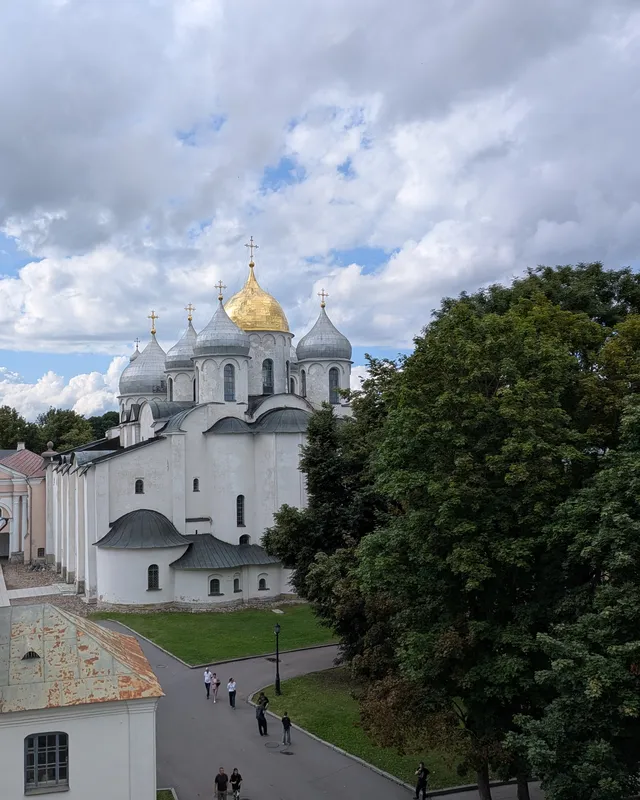
A 15th-century red-brick enclosure on the left bank of the Volkhov, planted with lawns where locals come to sit. Novgorodians say detinets, not kremlin: the word is older.
Built from 1045 to 1050, it is one of the oldest stone churches in Russia still in use. Thick walls, a dark interior and, on the west side, Romanesque bronze doors from the 12th century, brought from the West and filled with small figures.
A huge bronze bell unveiled in 1862 to mark a thousand years since the arrival of Rurik, covered with more than a hundred figures, from princes to writers. Walk around it slowly: it is a history lesson in three dimensions.
On the other bank, across the footbridge, the old market quarter: St. Nicholas Cathedral, founded in 1113, and a cluster of merchants' churches. Nearby, the Church of the Transfiguration of the Savior on Ilyina Street keeps frescoes by Theophanes the Greek, from 1378.
The Yuriev Monastery, a few kilometers south on the shore of Lake Ilmen, and its cathedral from 1119. Right next door, the Vitoslavlitsy open-air museum gathers wooden churches and log houses from all over the region: the two fit into the same half-day.
The first was found in July 1953; today there are more than a thousand, preserved by the clay. The most telling are displayed in the kremlin museum, including the drawings of Onfim, a 13th-century boy who got bored during his lessons.
When to go
Between Lake Ilmen and the marshes, the climate is damp: the warm season is short, but it is mild.
April – May
The ice leaves the Volkhov in April and the lawns of the Detinets turn green again in May. Cool, often windy days, and few visitors.
June – August
Very long days, almost white nights at the end of June, and mild evenings on the beach along the kremlin. Mosquitoes make themselves felt near Vitoslavlitsy and the lake.
September – October
September remains pleasant and the trees of the Detinets turn yellow. From October on, rain and wind off the lake make for shorter walks.
December – March
A gray, damp winter, between −5 and −10 °C (23 to 14 °F), with very short days. The ramparts under snow have their beauty, but Vitoslavlitsy and the outlying monasteries become harder to reach.
Practical information
From Moscow, an overnight train leaves Leningradsky station every evening and arrives early in the morning, in a little under nine hours. From Saint Petersburg, the Lastochka takes two to three hours depending on the train. We book the tickets with you.
The center, on both banks, can be done entirely on foot. For St. George's Monastery and Vitoslavlitsy, a few kilometers away, a taxi or a city bus will do.
Two days let you see everything without rushing. A single day from Saint Petersburg is possible, but then you give up the Yuriev Monastery and Vitoslavlitsy, or the museum.
Bank cards issued outside Russia do not work there: bring cash, euros or rubles, to exchange in town. Prices are much lower than in Saint Petersburg.
As for the visa: Novgorod has no international flights, you arrive via Moscow or Saint Petersburg, and that is where it is checked. What you need to know about the Russian visa in 2026 is on our page, and Venir en Russie explains every section of the form (in French).
Veliky Novgorod lies almost on the Moscow–Saint Petersburg line: it is the ideal stop between the two capitals, by overnight train one way and the Lastochka the other. With Pskov, a few hours' drive away, it makes up a circuit of the old republics of the northwest.
Other destinations:
Header photo: Vityavo, Wikimedia Commons (CC0).
Veliky Novgorod with us
In Novgorod, half the pleasure lies in knowing about the republic, the veche and the birch-bark letters; the other half, in finding the churches that matter open. We check the opening hours from here, we arrange the overnight train and the Lastochka, and an English-speaking guide meets you at the station.
Novgorod slips into two days between Moscow and Saint Petersburg.
Or let's talk first: we answer in English within 48 hours, with no commitment.