Adventurussia
Home Destinations Karelia
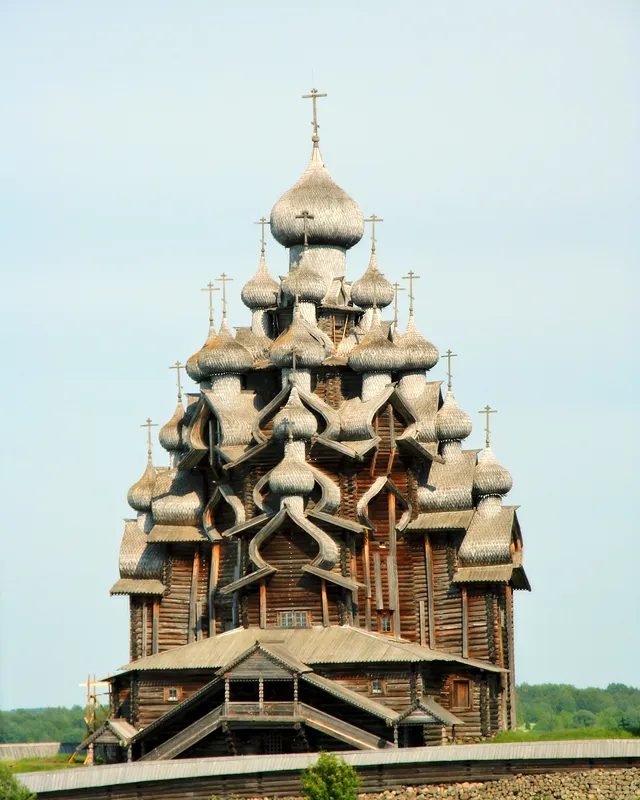
Lakes as far as the eye can see, pines on rocks polished by glaciers, a wooden church with twenty-two domes rising from the water as the boat draws near. Karelia is Russia's North, on the Finnish border: few towns, a great deal of water, and in June a light that hardly ever fades.
Why go
Karelia lies between two inland seas: Ladoga, the largest lake in Europe, and Onega, the second largest. On their islands, monks and peasants built some of the most remarkable things in Russia: the wooden churches of Kizhi, a UNESCO World Heritage Site since 1990, and Valaam Monastery, which survived the Soviet era in ruins before coming back to life. In between lie forests, marble quarries and rivers with rapids.
To be frank, this is a nature trip that depends on the weather and the boats. Kizhi and Valaam are only easy to reach in the warm season, the distances between sites are long, and the mosquitoes of June and July spare no one. In return, you will find a calm Russia, little visited by foreigners, with landscapes you would more readily associate with neighboring Finland.
What to see
Petrozavodsk for Onega, Sortavala for Ladoga: two bases, three or four hours' drive apart.
The capital of Karelia, founded in 1703 by Peter the Great around a cannon foundry. You don't come for the town itself, but its long lakeside embankment, lined with sculptures donated by its twin cities, is where you wait for the boat to Kizhi.
The Church of the Transfiguration, completed in 1714, carries twenty-two domes of silvery aspen, and the Church of the Intercession stands beside it. Around them is an open-air museum of peasant houses, windmills and chapels brought from all over the region. An hour and a half by hydrofoil from Petrozavodsk.
On an archipelago in Lake Ladoga: a Transfiguration monastery with blue onion domes, hermitages scattered through the forest, and monks who keep their orchards and workshops going. You get there by boat from Sortavala or Priozersk; the visit is simple and well organized, and modest dress is required.
The north of Lake Ladoga is cut into fjords and granite islets, the skerries. A boat trip from Sortavala, or a few hours of kayaking with a guide, shows the lake at its best, especially on a summer evening.
A former quarry opened in the 18th century, whose marble was used for Saint Isaac's Cathedral and the Marble Palace in Saint Petersburg, now flooded with turquoise water between its white walls. You walk around it, go down into the tunnels, and a vintage-style train runs up from Sortavala.
The Suna River drops ten meters (thirty feet) in four steps, in the middle of a nature reserve created in 1931, about 80 km (50 miles) from Petrozavodsk. A half-day trip, best combined with Martsialnye Vody, Russia's first spa, opened by Peter the Great.
When to go
Everything revolves around navigation: the boats to Kizhi and Valaam run from the ice breakup until the first fall storms.
May
The ice leaves the lakes, the waterfalls are at their fullest, and boats start running again toward the end of the month. Nights are still cool and some sites open gradually.
June – July
The sun barely sets, it is mild, and everything is open. This is high season, and mosquito season too: bring a strong repellent and long sleeves for the forest.
August – September
Our favorite season: fewer insects, blueberries and then mushrooms, birches turning yellow from mid-September. The boats are still running, but the wind can cancel a crossing.
December – March
Snow, frozen lakes, dog sledding, and on some evenings a chance of northern lights. Kizhi can only be reached by hovercraft when the ice allows, Valaam becomes hard to get to, and the Ruskeala canyon is lit up at night.
Practical info
Petrozavodsk is an hour and a half's flight from Moscow, or one night on a sleeper train, about eleven hours. From Saint Petersburg, the "Lastochka" train runs to Petrozavodsk and to Sortavala, the latter in about four hours.
A car with a driver is almost essential between Petrozavodsk, Kivach, Ruskeala and Sortavala: buses are rare and slow. For Kizhi and Valaam, the boats and their timetables set the day, and a windy day can shift everything.
Four days for the essentials: Petrozavodsk and Kizhi, Kivach, then Ruskeala and Valaam from Sortavala. Six days to add the Ladoga skerries, a night on Valaam or a day of hiking.
Bank cards issued outside Russia do not work there: bring cash in euros or US dollars and exchange it in Moscow or Saint Petersburg before heading north, as Sortavala and the Ladoga villages have hardly any exchange offices.
As for formalities, Karelia borders Finland, but that border is not a crossing point for travelers: you arrive via Moscow or Saint Petersburg, and that is where your visa is checked. Our guide to the Russian visa in 2026 explains which option to choose, and Venir en Russie (in French) helps you with the online application.
Karelia pairs first and foremost with Saint Petersburg, as its great outdoors: four hours by train, and you go from palaces to lakes. You can then head up to the White Sea and the Solovetsky Islands, whose boats leave from the Karelian coast, or continue to Murmansk and the Arctic on the same railway line.
Other destinations:
Header photo: Matthias Kabel, Wikimedia Commons (CC BY-SA 3.0).
Karelia with us
In Karelia, the challenge is not finding the places, it is linking them together: boat timetables that change with the wind, long roads with no buses, scarce lodgings on Valaam. We book your crossings and a private driver from Moscow onward, and build in a spare day for the weather.
Karelia adds four to six days to a stay in Saint Petersburg: your dates, your pace, a program written for you.
Or ask us first which season would suit you: our English-speaking team answers within 48 hours.