Adventurussia
Home Destinations The Solovetsky Islands
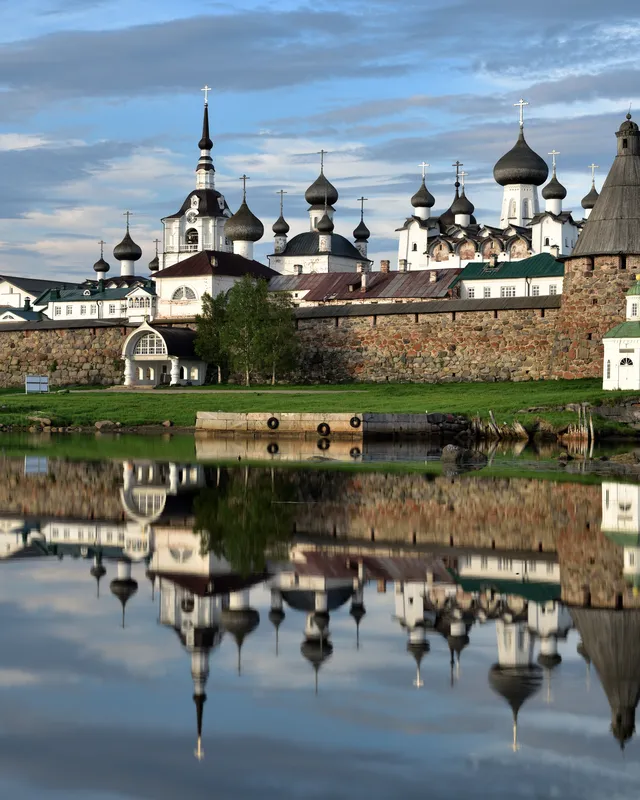
Walls made of round boulders, some bigger than a car, set at the edge of a gray sea where night never falls in June. The Solovetsky Monastery was founded in the 15th century by monks seeking the end of the world, then turned, in the 20th, into one of the first Soviet camps. You come here for both stories at once, and for the silence they left behind.
Why go
The first hermits, Savvaty and Herman, then Zosima, settled on the island in the 1430s. The monastery became one of the richest in northern Russia: it fished, salted, traded and, at the end of the 16th century, surrounded itself with a wall of glacial boulders that withstood sieges. The whole site, monastery, dams, canals and ancient remains, has been a UNESCO World Heritage Site since 1992.
In 1923 the Soviet regime opened the Solovki Special Purpose Camp here, known as SLON, the prototype of what would become the Gulag. Priests, officers, intellectuals, peasants: tens of thousands of prisoners passed through the archipelago until the prison closed in 1939. Monks have been back in the monastery since the 1990s, and a visit means holding both memories together. It should also be said: this is a long trip, demanding in logistics, and its season lasts only three and a half months.
What you will see
The monastery first, then the islands one by one: boats and trails depend on the wind, so keep a spare day.
A wall one kilometer around, built between 1584 and 1594 from glacial boulders, and behind it the cathedrals, the refectory and the cells. Part of it is restored, part still under restoration; the museum tells the story of both the monks and the camp.
The exhibition on the camp, in the former prison buildings, the barracks and the cemeteries scattered through the forest. It was from this island that the Solovetsky Stone was brought, set up in 1990 in front of the Lubyanka in Moscow in memory of the victims of political repression.
On an islet half an hour away by boat, spirals of stones laid on the tundra thousands of years ago, whose exact purpose no one knows. About thirteen of them lie close together; you walk past them on a wooden boardwalk, without stepping inside.
A wooded hill about twelve kilometers from the monastery, crowned by a church that also serves as a lighthouse. During the camp years it was the most feared punishment cell on the archipelago. A long wooden staircase leads down from it, and the view over forests and ponds stretches to the sea.
The wildest of the inhabited islands, with its hermitages, including Golgotha at the top of a hill. Access is regulated and only possible on an accompanied excursion, by boat, over one day: book well before you leave.
A dam of stone blocks about a kilometer long, built by the monks in the 19th century to link two islands, and a network of canals between the lakes of the main island. You explore them by bike or by rowboat, at the archipelago's pace.
When to go
Boats run from June to the end of September: outside that window you can only come by plane, and almost everything is closed.
May
The ice leaves the White Sea late, often in May, and boats only resume in June. Spring is not a visiting season here.
June – July
The sun barely sets and the light lasts all night. This is the heart of the season, along with the mosquitoes that come with it: repellent and long sleeves are a must.
August – September
Darkness returns, the mosquitoes leave, and berries ripen in the forest. Mid-July to mid-August is the busiest period; September is quieter and cooler, and the sea is rougher.
October – April
The sea freezes, the boats stop, and only flights from Arkhangelsk still serve the island. Fewer than a thousand residents stay on: a possible experience, but not a sightseeing trip.
Practical information
By train from Moscow to Kem, in Karelia, about seventeen hours on the fastest service, then two hours by boat from the nearby port of Rabocheostrovsk. Or by plane from Arkhangelsk, about an hour's flight. Seats are scarce in high season: we book the tickets with you, very early.
A single village around the monastery, and dirt tracks. You get around on foot, by rental bike, and by boat or off-road vehicle for the distant sites, on the museum's organized excursions.
At least three full days on the island, four for Anzer, plus two days of travel each way from Moscow. The weather often decides: a spare day keeps you from missing the return boat.
Bank cards issued outside Russia do not work there, and the island has few ATMs: bring enough rubles in cash from the mainland. Accommodation and excursions cost more than the Russian average, for lack of competition.
As for entering Russia: the archipelago requires no special permit, only your regular visa, checked on arrival in Moscow or Saint Petersburg. Which Russian visa to apply for in 2026 is on our page; Venir en Russie shows how to fill in the application (in French).
The road to Solovki runs through Karelia: the Kem train skirts Lake Onega, and Petrozavodsk or Kizhi fit in easily on the way there or back. Coming via Arkhangelsk, you then return through Moscow; and those who want to go further north continue to Murmansk, on the same railway line.
Other destinations:
Header photo: Александр Байдуков, Wikimedia Commons (CC BY-SA 4.0).
The Solovetsky Islands with us
Sold-out trains, the morning boat, scarce lodging, excursions with limited places, Anzer by permit only: on Solovki, whatever you haven't booked ahead simply doesn't exist. We put it all together in advance, with a margin for the weather, and an English-speaking guide to tell the story of the monastery and the camp.
The Solovetsky Islands combine with Karelia in one week, travel included.
Or ask us first what is possible on your dates: we answer in English within 48 hours.