Adventurussia
Home Destinations Nizhny Novgorod
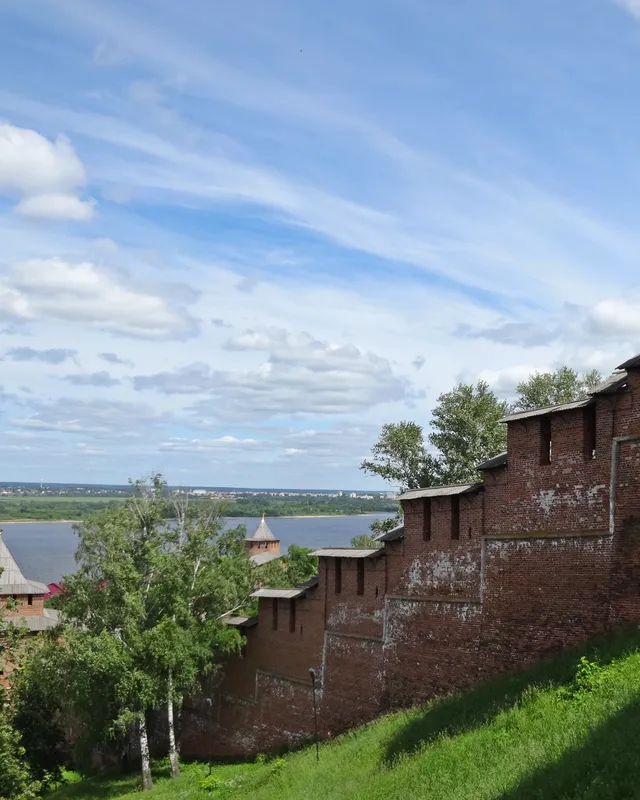
From the top of the ramparts, you can watch the brown Oka flow into the wider, grayer Volga, the two waters running side by side for a while before they mix. Nizhny Novgorod has stood on this bluff since 1221: a city of merchants and boatmen, long closed to foreigners, that you can explore on foot in two days.
Why go
From 1932 to 1990 the city was called Gorky, and it was closed to foreign visitors: cars, submarines and radars were built here. This is where Andrei Sakharov was sent into internal exile. Those closed years left a city with little tourism, where you mostly meet Russians on a weekend away, and where the embankments, cafés and museums were never designed for tour buses.
What makes it easy is the geography: an upper town on the bluff, a lower town by the water, and stairways everywhere to get from one to the other. In one day you can see the kremlin, the pedestrian street and the confluence; the second day is for the cable car, the merchants' churches and the lower town. What makes it less easy is that you need to enjoy walking, and climbing.
What you will see
The kremlin in the morning, the confluence at sunset: that is when the light falls on the water.
A red-brick enclosure built between 1508 and 1515, two kilometers long, running down the slope to the foot of the bluff. Part of the wall walk is open: that is where the view over the Volga is widest.
Built after the war to link the upper town with the embankment, they descend in two branches that cross like a figure eight, below the statue of the aviator Valery Chkalov. Going down is easy; the climb back up, several hundred steps later, takes some planning.
The city's main pedestrian street, from the kremlin to Gorky Square: late 19th-century bank and hotel façades, street musicians, life-size bronze statues. You stroll, you stop, you have dinner.
More than three and a half kilometers of cable across the river to the town of Bor, on the far bank. About twelve minutes in the cabin, and the finest overall view of Nizhny: the ramparts, the domes, the whole bluff.
At the tip of the Strelka, where the two rivers join, stand the Alexander Nevsky Cathedral and a large new embankment. From the kremlin you can clearly make out the two colors of water touching without mixing right away.
The merchants' street of the lower town, along the Oka, and at its end the Church of the Nativity, built by the Stroganov family around 1700: a confection of carved white stone and one of the finest examples of the so-called Naryshkin Baroque.
When to go
The city is lived outdoors, on the embankments and the stairways: summer and early fall are the safest bets.
April – May
The ice leaves the Volga in April and the embankments come back to life in May. Cool but bright days, and still few people on the pedestrian street.
June – August
The longest days, open-air terraces, boats on the river. It gets hot, sometimes above 30 °C (86 °F), and the sunsets over the confluence come late.
September – October
September is often the best month: the trees on the bluff turn yellow, the weather is mild and the city has found its rhythm again. In October the cold comes quickly, and the cable car may stop in high winds.
December – March
Around −15 °C (5 °F) on average, the Volga frozen white below the ramparts. Beautiful for a day, harsh for two: icy stairways make the city less pleasant on foot.
Practical information
The Lastochka train leaves from Moscow's Kursky station several times a day and takes about four hours, stopping in Vladimir. You can leave in the morning and start sightseeing that same afternoon. We book the tickets with you.
The historic center is best seen on foot, but it goes up and down constantly: good shoes matter more than a map. For the confluence or the train station, across the Oka, a taxi or the metro will do.
Two full days for the city. A third day lets you go down the Volga to the Makaryev Monastery, about ninety kilometers away, or stop in Vladimir on the way back.
Bank cards issued outside Russia do not work there: bring cash, in euros to exchange locally, or in rubles. Nizhny Novgorod is noticeably cheaper than Moscow, for meals and hotels alike.
As for paperwork: there are no direct flights from Europe or North America to Nizhny Novgorod, you arrive via Moscow, and that is where your visa is checked at the border. Our guide to the Russian visa in 2026 explains which one to choose depending on your nationality, and Venir en Russie's step-by-step guide (in French) walks you through the application.
Nizhny Novgorod is the natural next step after a stay in Moscow, four hours away by train, and the line runs through Vladimir: a stop in the Golden Ring is easy to add. Heading further east, Kazan is the next major city on the Volga, and it is also the first big stop on the Trans-Siberian.
Other destinations:
Header photo: amanderson2, Wikimedia Commons (CC BY 2.0).
Nizhny Novgorod with us
The merchants' fairs, the Gorky years, the closed city, Sakharov in exile: without someone to tell these stories, all you see are pretty façades. We arrange the trains and the hotel from here, and an English-speaking guide meets you at the station.
Two days in Nizhny fit easily into a stay in Moscow, round-trip train included.
Or ask us your questions first: we answer in English within 48 hours.