Adventurussia
Home Destinations The Golden Ring
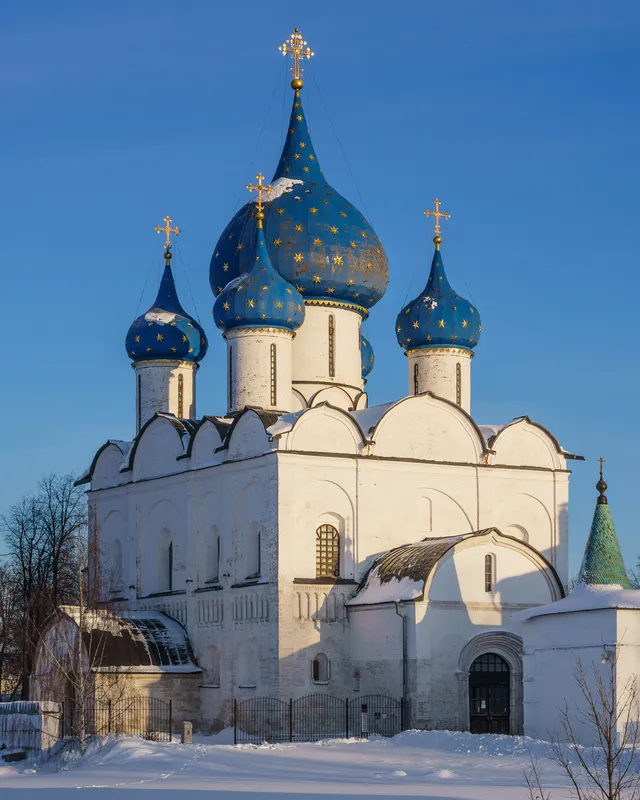
Bell towers ringing above the meadows, ramparts of wood and brick on the shores of lakes, white-stone churches older than Moscow. The Golden Ring is the Russia that came before Peter the Great, one to four hours from the capital, and it is where most Russians take their friends from abroad.
Why go
In the 12th century, Moscow was no more than a fortified outpost; the capital of the principality was Vladimir, and the princes were building Suzdal, Pereslavl and Rostov. The white-stone churches of that era are still standing, and eight centuries of Russian history then unfold town after town, up to the painted brick churches of 17th-century Yaroslavl. UNESCO listed the monuments of Vladimir and Suzdal in 1992, the Lavra of Sergiev Posad in 1993 and the center of Yaroslavl in 2005.
The Golden Ring is not an official route but a name given in the 1960s to a loop of old towns northeast of Moscow. What ties them together is their scale: small towns, often barely bigger than a village, where you walk from one monastery to the next and evening falls over quiet streets. You have to accept that not everything is restored, and that some towns look a little tired between two gems: this, too, is provincial Russia as it really lives.
What to see
In route order starting from Moscow: you can do the loop in either direction, or take just half of it.
The great monastery of the Russian Church, founded in the 14th century by St. Sergius of Radonezh, forty-three miles from Moscow. Monks, pilgrims, blue domes studded with golden stars: one morning is enough, and it is the natural first stop.
A Cathedral of the Transfiguration completed in 1157, one of the oldest in Russia, and on the lakeshore the Botik Museum, which keeps the Fortuna, the last boat of the small flotilla the young Peter the Great had built here.
Built by Metropolitan Jonah in the 1670s and 1680s on the shore of Lake Nero, it is not a fortress but a fortified bishop's residence, with churches set atop its gates and a belfry famous for its bells. Rostov is also the home of finift, painted enamel.
The largest and liveliest town on the ring. Its 17th-century churches, led by St. Elijah the Prophet, are covered in frescoes from floor to vault, and the Volga embankment is made for an evening stroll.
It was within these walls that the young Michael Romanov learned in 1613 that he had been elected to the throne: the dynasty began here. Right next door, an open-air museum of wooden architecture brings together log houses, windmills and churches from all over the region.
Suzdal is a museum village of some ten thousand inhabitants and dozens of churches, where you stay overnight to enjoy the evening. Twenty-two miles away, Vladimir keeps its Golden Gate from 1164, the Dormition Cathedral with frescoes by Andrei Rublev, and St. Demetrius with its carved façades; the Church of the Intercession on the Nerl stands a few miles away, alone in a meadow.
When to go
All year round, to be honest: these are towns, not trails. But the light and the roads change a great deal from one season to the next.
April – May
Mud from the snowmelt in April, then the first greenery in May. Few visitors, gentle prices, and Orthodox Easter, if it falls during your stay, is lived to the full in the monasteries.
June – August
The best season for Suzdal and its meadows, walks along the Volga, long evenings. It is also the season of tour groups and Muscovites on weekend trips: better to visit on weekdays.
September – October
The birches turn yellow in late September and the towns empty out. It is cool, sometimes damp, but this is the season we prefer for Rostov and its lake.
December – March
Domes under snow, sleigh rides in Suzdal, New Year and Maslenitsa festivities. The days are short and the cold can drop below −4°F (−20°C): you sightsee less, and warm up more.
Practical info
Everything starts from Moscow. The Lastochka train reaches Vladimir in one hour forty and Yaroslavl in three and a half hours; Sergiev Posad is one hour away. Suzdal has no railway station: you get there by bus from Vladimir, in forty-five minutes.
The towns of the ring are poorly connected to one another: a bus here, a train there, timetables that don't match. A car with a driver changes everything, especially to link Pereslavl, Rostov and Yaroslavl in a single day. In each town, you explore on foot.
Two days for Vladimir and Suzdal alone. Four to five days for the northern loop (Sergiev Posad, Pereslavl, Rostov, Yaroslavl, Kostroma). Six days to do it all without rushing, with two nights in Suzdal.
Bank cards issued outside Russia do not work there: bring euros or dollars in cash and exchange them in Moscow, where exchange offices are far more common than in the provinces. Admission to monasteries and museums is paid on site, often ticket by ticket.
As for formalities, the Golden Ring is visited from Moscow, and it is on arrival in Moscow that you present your visa. To find out which one to apply for, read our guide to the Russian visa in 2026; and if the online form stops you in your tracks, Venir en Russie explains it field by field (in French).
The Golden Ring is the natural complement to a stay in Moscow: three days in the city, three days in the provinces, and you have seen both faces of the country. Vladimir lies on the road to Nizhny Novgorod, and Yaroslavl can open the door to the Trans-Siberian, whose historic line passes through it. Those who love old stones will continue to Veliky Novgorod and Pskov, on the other side of Moscow.
Other destinations:
Header photo: A.Savin, Wikimedia Commons (FAL).
The Golden Ring with us
On your own, you spend as much time in bus stations as in churches on the Golden Ring, and the frescoes stay silent without someone to read them. We arrange the driver, the nights in Suzdal and an English-speaking guide who knows these towns well, from Moscow, where we live.
Vladimir and Suzdal can be added to Moscow in two days; the full loop, in six.
Or ask us your questions first: we answer in English within 48 hours.